The Ramsays’ dinner party
To the LighthouseThe Ramsays’ dinner party turns domestic work into a fragile act of making a world. Mrs Ramsay must manage the timing of a meal, the anxieties of her guests, and the emotional currents around the table; for a time, candlelight, conversation, and a great dish of boeuf en daube gather separate people into a common scene. Yet the evening’s harmony does not erase their differences. It is sustained by Mrs Ramsay’s effort, and its most complete moment is already passing as she leaves the room.
Preparation and Occasion
Mrs Ramsay wants the dinner to be particularly good because William Bankes has finally agreed to come. With fifteen people expected, timing matters: the boeuf en daube, made with beef, bay leaf, and wine, must be served at precisely the right moment. The guests she is waiting for, Minta Doyle and Paul Rayley, are late, so food has to be sent out and kept hot. Mrs Ramsay fears the dish will be spoiled. The meal’s apparent ease is therefore constructed through a practical, tightly timed effort that the guests need not see.
While the dinner is delayed, the children help Mrs Ramsay prepare for it. Rose may choose the jewels she will wear, and Jasper offers an opal necklace while Rose offers a gold one. Mrs Ramsay asks which will look best with her black dress, looking at her neck and shoulders in the glass but avoiding her face. She has also refused the children’s exaggerated pleas for jewels, and, when she is ready to go downstairs, arranges their ceremonial roles: Jasper will offer his arm as the gentleman, Rose will carry her handkerchief as the lady, and someone must choose a shawl in case it is cold. The small staging of her entrance sits beside the less theatrical concern that the dinner may be burning.
Before the meal can begin, Minta and Paul return with a maid carrying the great dish. Their lateness has made Mrs Ramsay more annoyed than relieved, but she cannot ask them what happened in front of the assembled company. She descends into the hall as if receiving silent tribute, aware that the others cannot yet tell her their news. A smell of burning briefly interrupts the ceremony: she wonders whether the boeuf en daube has boiled over just as the gong summons the scattered household to dinner.
A Table of Separate Lives
At the head of the table, Mrs Ramsay looks at the white circles of the plates and asks herself what she has done with her life. Paul and Minta are together; she has only the long table, plates, and knives. Mr Ramsay sits at the far end, frowning, and she feels distant from him, unable to recover the emotion she once felt. As she serves soup and the guests take their places, she waits passively for an answer or for something to happen, yet recognizes that such a feeling is not something to announce aloud.
For a time, the room seems to confirm her estrangement rather than overcome it. Looking around, she sees its shabbiness and feels that nothing has merged: the guests remain separate, and she is outside the shared current. She thinks of the effort of joining them as work that would go undone if she did not undertake it. Then, by turning herself back toward the company, she feels a weak pulse resume. She attends to William Bankes, who has no wife or children and usually dines alone in lodgings, and begins again to sustain the occasion. The care is neither effortless nor simply cheerful; she continues despite weariness, like a sailor who feels a wind fill the sail without wanting to set out again.
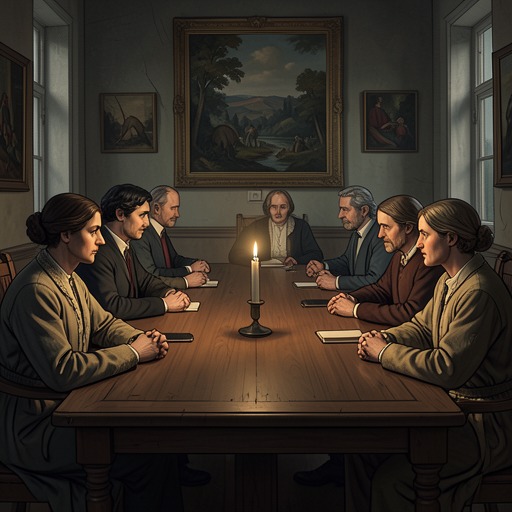
The candles alter the scene. Eight flames first stand upright, then make the whole length of the table visible, with Rose’s arrangement of grapes, pears, a shell, and bananas at its centre. To Mrs Ramsay, the fruit looks like a trophy brought up from the sea, and its scale seems to open into a landscape of hills and valleys. Augustus Carmichael looks at the same dish, breaking off a bloom and a tassel before returning to his meal. Their ways of seeing it differ, but looking together briefly brings them into sympathy.
As all the candles are lit, the faces draw nearer and the diners become a party. The panes of glass ripple the outside world until the room seems like dry land set against the wavering dark beyond it. Mrs Ramsay’s earlier uneasiness changes to expectation; Lily Briscoe senses the sudden exhilaration as a release of weight. The company seems to share a temporary shelter from the fluidity outside, though the latecomers have still not arrived. When Minta and Paul finally enter, they find their places at different ends of the table and apologize for being late.
The Brooch and the Meal’s Triumph
Minta announces that she has lost her grandmother’s brooch. Her lament and the look in her eyes rouse Mr Ramsay’s chivalry, and he teases her for scrambling about the rocks in jewels. Once seated beside Mrs Ramsay, Paul explains that they went back to look for it. Mrs Ramsay notices that he has said “we,” a small change of language that carries the news of a new shared identity. She anticipates that they will go on saying “we,” and the lost brooch becomes part of the evening’s evidence that their attachment has taken shape.
The food gives that news a public form. The cook has spent three days on the dish, and as Marthe lifts the cover, the smell of olives, oil, and juice rises from it. Mrs Ramsay takes care to choose a tender piece for William Bankes. The effort of the cooking and the private consequence of Minta and Paul’s return meet at the table: she feels that the meal can celebrate the occasion, even while she holds together two responses, tenderness toward the seriousness of love and amusement at the lovers’ entry into its glittering illusion.
William Bankes calls the dish a triumph, praising its richness, tenderness, and perfect cooking. Mrs Ramsay tells him it is a French recipe from her grandmother. They agree that English cookery is poor, especially its habit of wasting the nutritious skins of vegetables. Bankes’s admiration restores her awareness of his affection and reverence; she laughs and gestures, pleased that the evening has succeeded. Lily sees the force of Mrs Ramsay’s presence: her wish has helped bring the diners and the occasion together, even as she can laugh at the romantic drama she has helped foster.
A Moment of Coherence
Mrs Ramsay’s success is not simply that the food is well received. For a moment, she feels secure among her husband, children, and friends. The feeling seems to rise from the whole company, not from any single declaration, and she senses that nothing needs to be said. She understands the stillness as something coherent and stable, shining against what flows and vanishes. The dinner does not abolish uncertainty; rather, its temporary stillness lets her recognize a form of endurance within ordinary experience.
From that moment of inward peace, Mrs Ramsay can return to the practical rhythm of the meal. She makes sure there is enough for everyone and warns Andrew to hold his plate lower so she will not spill. Then she listens to Mr Ramsay discussing the square root of 1,253, a number on his watch. Mathematics and learned talk sustain her without being her own subjects: she trusts the intellectual fabric the men are making, though she does not follow its details. The scene distinguishes her sustaining, largely domestic labor from the masculine conversation that appears to uphold the world, while showing how she leans on that conversation as part of the table’s shared life.
Her attentive quiet also allows her to notice how different guests inhabit the same conversation. Charles Tansley’s interventions seem entangled with his concern about the impression he makes; Paul Rayley, by contrast, speaks modestly about books read as a boy and is considerate of whether Mrs Ramsay feels cold or would like a pear. When discussion of literary reputation touches Mr Ramsay’s anxiety about whether work will last, William Bankes declines to make that question a measure of personal worth. He says, “Let us enjoy what we do enjoy,” and Mrs Ramsay recognizes that her husband is becoming uneasy and wants encouragement. Minta, sensing the strain, turns the conversation by saying she does not believe anyone really enjoys reading Shakespeare. The exchange lets Mrs Ramsay see the table as a pattern of distinct thoughts and feelings, briefly held together without her having to separate and manage every voice.
Poetry, Departure, and the Past
As dinner ends, the company continues talking and laughing while Mrs Ramsay waits for the right moment to rise. The bursts of laughter and Minta’s voice alone recall, to her, the sound of a service in a cathedral. Then Mr Ramsay speaks in the rhythm of a poem, beginning “Come out and climb the garden path, Luriana Lurilee.” The familiar verse gives the gathered voices a shared cadence; Mrs Ramsay feels relief and pleasure, as if it were a natural expression belonging to them all.
The moment shifts when Augustus Carmichael rises, holding his napkin like a long white robe, and chants the next lines. He bows to Mrs Ramsay as if paying homage. She feels that he likes her more than before and returns his bow with gratitude. The evening’s gestures have joined admiration, play, poetry, and hospitality without making them identical: the company can share a scene while each person retains a separate inward life.
With one foot on the threshold, Mrs Ramsay pauses to take in the scene. As she moves away with Minta’s arm in hers, the gathering changes shape in her perception and becomes the past. The dinner’s achievement is thus inseparable from its brevity. Its order has depended on food, timing, candlelight, conversation, and Mrs Ramsay’s attention; once she leaves, the company begins to disperse in different directions. The party endures not as a permanent reconciliation, but as a moment whose transience is part of what gives it form.